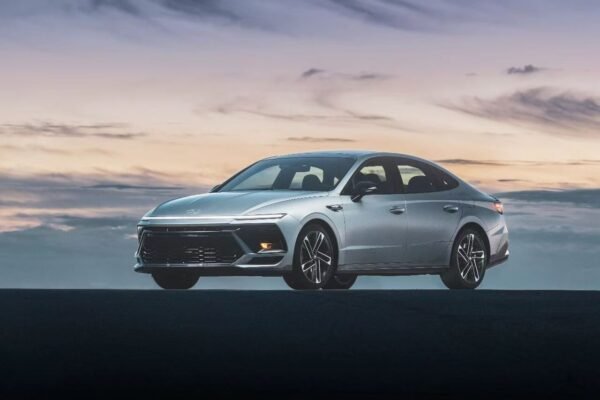
The Hyundai Sonata. Why would anyone still choose it in 2026?
The story begins in 1985 when the first-generation Sonata was launched with a sense of catching up. But the Sonata has always been a car that knows how to make a splash. It once invited the master designer Giorgetto Giugiaro to handle the second-generation model. After the millennium, it also threw a “bombshell” into the then generally mediocre B-class car market with its unique “Fluidic Sculpture” design language. From then on, it understood a principle: it’s better to impress some people first than to try to please everyone. This pursuit of design is deeply ingrained in its DNA.
Fast forward to today in 2025, and we see the 11th-generation Sonata. The official design concept for this car is “Starship”. You can see the continuous horizon light group and a very exaggerated sporty front face. The car measures 4,945mm in length and has a wheelbase of 2,875mm, which is a standard B-class car size.
In terms of power, it offers you two choices: a 1.5T engine for daily use and a 2.0T engine that emphasizes driving experience. The maximum power reaches 125kW and 184kW respectively, and both are paired with an 8AT transmission. Especially the 2.0T N Line version, with its dual four-exhaust pipes, the sporty feel is maximized.
Since it’s a B-class car, it can’t avoid the two “big brothers”: the Toyota Camry and the Honda Accord. Simply put, compared to these two, the Sonata’s strategy is very clear: niche competition. It admits that it lags behind in brand appeal and resale value. But its advantage is offering you stronger power and richer configurations at a lower price. For example, at the same price, you might only get the 1.5T version of the Accord, while the Sonata can already offer you a 250-horsepower 2.0T.
The interior features a standard 12.3-inch curved dual screens, giving it a strong sense of technology. In contrast, the low-end models of the Camry might still have small screens. So some people say that choosing the Sonata is like buying a B-class car with decent power and configuration with the budget of a mid-range A-class car.
Three advantages, three drawbacks.
- Advantage one: The appearance is really “on point”. In an era of “clone” designs everywhere, its design is highly distinctive, almost tailor-made for young users who pursue individuality.
- Advantage two: The space and seats are very comfortable. Despite its sloping roof, the rear legroom is more than two fists. The seat support and angle are well designed, making long rides comfortable.
- Advantage three: The power matching is mature. Especially the 2.0T + 8AT combination, the power output is smooth and responsive, giving a light and lively feeling when driving.
- Drawback one: The fuel consumption is not low. The 1.5T version is about 8.5 liters in the city, and the 2.0T easily exceeds 10 liters. You have to pay more at the pump for this power and individuality.
- Drawback two: The interior texture has a “discrepancy”. It looks very sci-fi, but touching some areas of hard plastic reminds you of its price. The details don’t stand up to the most rigorous scrutiny.
- Drawback three: Noise control is a weak point. Especially at high speeds, wind and tire noise can be quite noticeable inside the car, affecting some of the premium feel.
The current situation of the Sonata is like a mirror, reflecting on one side the Hyundai Group’s success in performance and electric vehicles globally, and on the other side, the domestic market’s reliance on “price cuts for volume” to attract attention. It reveals the microcosm of traditional B-class fuel cars in the face of the electrification wave. When technological advantages are quickly eroded, apart from competing on reputation and resale value, they can only attract those “non-conformists” with extreme individual design and niche pricing, like the Sonata.
So why would you choose the Sonata? You’re not choosing a label that follows the trend, but a stance. Refuse to be uniform within a limited budget. Use less money to buy more power, a more unique design and the courage to not cater to the mainstream. It may not be the safest or most valuable one, but it is definitely the one that makes you look back twice in the parking lot. This Sonata, with its starting price in the 110,000 yuan range, might just be the “answer car” with a bit of rebellious spirit prepared for you in the “greasy” mid-size car market. Choosing it is more like choosing an attitude. The car is for yourself, and what you like is more important than anything else.