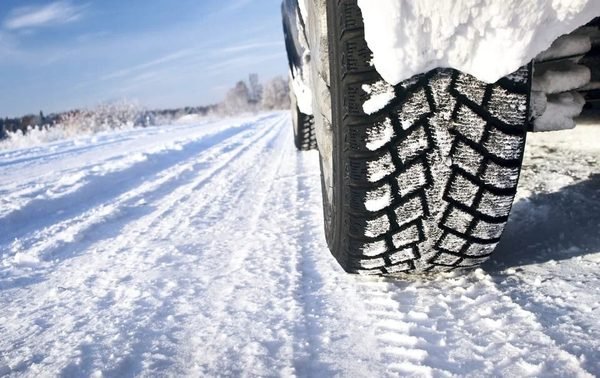
Same car, same speed, same pedal — but on all-season tires, the ice braking distance can double. It’s not driver skill; it’s rubber hardening in the cold and tread that can’t bite into ice.
- Why: Cold Turns the Tire Into a Different Material
- Rubber hardens. All-season compounds are designed for year-round use, with an optimal range roughly above 7°C (45°F). Below that, the tread compound stiffens noticeably, and below about -10°C it approaches a “plastic” state with much lower friction. Winter tires use high-silica, soft compounds that stay flexible in the cold.
- The tread can’t grip ice. All-season patterns prioritize water evacuation and dry/wet grip, with limited siping. Winter tires have thousands of micro-sipes that scrape the ice film and create edge bite. Ice also carries a pressure-melted water film; winter compounds absorb it, all-seasons can’t.
- How big the gap is. Tire Rack’s ice braking test at 10 mph: winter tires stopped in about 21 ft 2 in, all-seasons in about 39 ft 10 in — roughly 88% longer. At 30 mph on snow, all-seasons needed about 30 extra feet. In a 30–0 mph ice test, winter tires took 48 ft versus 85 ft for all-seasons. In a 25 mph ice cornering test, the all-season car slid off the track.
- North America amplifies the risk. Quebec mandates winter tires from December 1 to March 15; BC mountain routes require 3PMSF or chains from October 1 to April 30; northern US snow belts have no single mandate but plenty of black ice, bridge ice, and freezing rain.
- Common myths. AWD and ABS improve launch and brake control but cannot add grip between tire and ice; “M+S” is only a mud-and-snow marking, not a severe-snow certification; only the three-peak mountain snowflake (3PMSF) carries a tested winter threshold.
- Impact on Vehicle Use
- Doubled braking distance: at intersections or in sudden stops, those extra tens of feet are the difference between stopping and hitting.
- Loss of steering and lane-change control: all-seasons push or slide in icy corners, and ESP can only work within physical limits.
- Fines and compliance: Quebec penalties start at CAD 200 for missing winter tires.
- Insurance and fleets: higher winter crash rates, premiums, and downtime.
- Myth cost: “I have AWD” doesn’t help when the tires can’t brake on ice.
- Solutions
- Switch to winter tires or 3PMSF all-weather tires. Dedicated winter tires for snow-belt and mountain driving; 3PMSF all-weather for milder climates with cold snaps. Replace all four — front-only swaps upset handling balance.
- Use the “7-7 rule.” Switch when the daily average stays at or below 7°C for seven consecutive days; reverse the rule in spring.
- Check tread and pressure. Winter tread depth should be at least 4 mm; cold weather lowers pressure naturally, so check monthly.
- Use studs legally. Where permitted by state or province, and within seasonal and road restrictions.
- Adjust driving habits. Double following distance, brake early and gently, slow down for corners, and avoid hard acceleration or steering inputs on ice.
- Store correctly. Keep off-season tires out of sunlight in a dry place, away from oil and ozone.
Bottom line:”all-season” comes with a temperature caveat. In a North American winter, the right tire for the temperature shortens those tens of feet better than any driving technique.