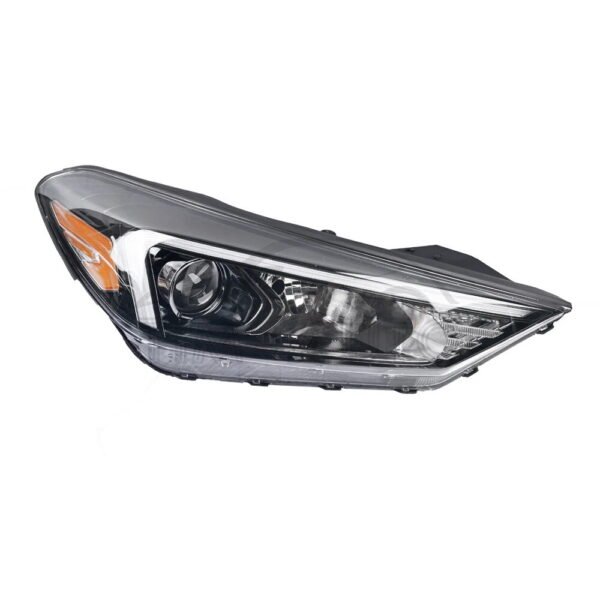
Heat in an LED headlight follows a fixed path: chip → thermal grease or thermal pad (TIM) → heat sink body → fan and air. If any link in that chain degrades under North American conditions, the result shows up as dimmer output, color shift, thermal shut-off, and eventually aged seals and fogging.1. The Heat Sink Body: the Thermal BackboneThe heat sink is usually an aluminum extrusion (6063 is common) with fins; premium assemblies add copper heat pipes. Its job is to spread heat over a large area, conduct it away from the chip, and buffer some thermal mass.How North America affects it:Road-salt corrosion.Winter road salt attacks aluminum with chloride pitting, reducing both thermal conductivity and structural strength; salt spray also corrodes joints, fasteners, and circuitry.
– Thermal-cycling fatigue. From -30°C cold to 40°C+ summer heat, repeated expansion and contraction loosen fins and crack solder joints, degrading the heat path.
– Dust and slush blockage.Dust in the Southwest and snow slush in winter pack into fin gaps and act as insulation — neglected fins can lose roughly 15–25% of cooling performance.
– Insufficient margin in summer.Hot ambient air lowers heat-transfer efficiency, forcing the fan to run longer and harder.
2. Thermal Grease / Thermal Pad: the Most Overlooked Link
TIM fills microscopic gaps between the chip and the heat sink to cut contact resistance. Its failure is silent but is a common root cause of light decay.How North America affects it:
– Pump-out. The chip, grease, and heat sink expand at different rates, so repeated thermal cycles squeeze grease from the center of the interface toward the edges, creating voids. Testing shows interface resistance can rise 20–50% after 500–1,000 cycles, and production lamps can develop “dry zones” within 1–2 years.
– Dry-out at high temperature. Silicone oil volatilizes and the material hardens, lowering conductivity.
– Moisture and salt spray. Water vapor entering the interface accelerates corrosion and raises contact resistance further.
– Improper pad compression. A pad that is too hard or under-compressed contacts poorly and shows high resistance.
Symptoms: local hotspots, lower brightness, yellower color, shorter life — often with no visible external sign.
3. The Cooling Fan: the Last Mile of Active Cooling
The fan forces convection across the heat sink and is the core of active cooling.How North America affects it:
– Slush, salt spray, and dust enter the bearings.Wear accelerates, RPM drops, noise appears, and the fan may stop; salt spray is especially corrosive to bearings and electronics.
– Hard cold starts. In severe cold, lubrication worsens and the fan starts slowly or intermittently.
– Ice and snow block the intake. Airflow is choked and cooling effectively fails.
Symptoms: junction temperature spikes, thermal protection derates or temporarily shuts the lamp off, and brightness drops noticeably.
4. The Compounding Chain
TIM pump-out + heat-sink corrosion + fan failure → higher junction temperature → light decay and thermal protection → sustained heat ages sealant and warps or yellows the lens → moisture enters → fogging and water intrusion → fog and water further hurt optics and cooling → a vicious cycle.
5. What to Do
For drivers:
1. Clean fins and intakes periodically — compressed air is enough.
2. Avoid close-range pressure washing of the lamp body.
3. Act on fan noise or dimming early, before light decay becomes permanent.
4. Garage the car in snowy weather to reduce thermal shock and salt exposure.
For factories:
1. Anodize or coat the heat sink to improve salt-spray resistance.
2. Use automotive-grade TIM (-40 to 125°C, pump-out resistant, low volatility), and control pad compression and hardness.
3. Specify IP-rated, salt-spray-resistant fan bearings and design intakes that resist slush.
4. Validate with thermal simulation covering North American extremes: -30°C cold start, 40°C summer long drives, salt-spray cycling.
5. Validate sealing alongside thermal design — don’t fix cooling at the cost of sealing.
Bottom line:North America tests the durability of the whole thermal chain, not a single part. A corrosion-resistant heat sink, a pump-out-resistant TIM, and a salt-spray-resistant fan — pass all three, and the headlight will hold up from deep winter to summer heat.