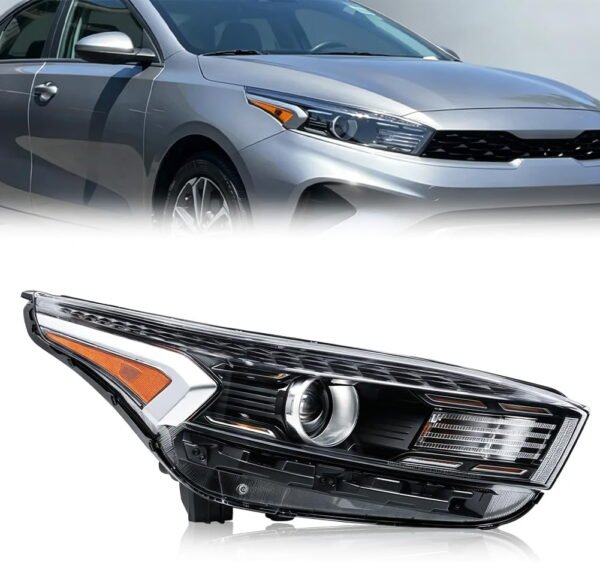
On a blizzard night or during freezing rain, many North American drivers hit the same dangerous moment: the wipers are clearing the windshield, but the road ahead keeps getting darker — the headlight lens is covered in snow and sealed under a layer of ice. The bulb isn’t broken; the light simply can’t get out.
- The Chain: From Sticking Snow to an “Ice Shell”
- Wet snow sticks. Snow near 0°C is the stickiest; airflow at speed keeps pressing flakes onto the lens face, while road salt and slush add a muddy film.
- It melts, then refreezes.Daytime sun, residual heat after parking, and the lamp’s own temperature melt part of the snow; as temperatures drop at night or during high-speed driving into the wind, the meltwater refreezes into a clear or translucent ice layer — the “blocking layer.”
- The LED “cold light” weakness. Halogen lamps turn about 95% of their energy into heat, pushing lens surface temperatures up to 150°C — effectively a built-in defroster that melts snow on contact. LEDs concentrate heat at the chip base and move it away with heat sinks and fans, so the lens stays near ambient temperature (roughly 45–55°C). Wet snow doesn’t melt; it piles up. Testing shows a lens can be completely iced over after about 20 minutes of highway driving, with a sharp drop in output.
- Optics amplify the problem. LED beams are tightly focused, so an ice layer as thin as 0.3 mm is enough to distort and scatter the beam, cutting reach and intensity. Uneven ice also deforms the beam pattern.
- North America amplifies it. Great Lakes snow belts, Canadian blizzards, freezing rain, salt spray, long night drives, and sustained low temperatures keep the stick–melt–refreeze cycle repeating.
- Impact on Vehicle Use
- Night visibility collapses, leaving too little reaction time to spot obstacles and pedestrians.
- Beam shape changes: less road illumination ahead, or extra glare for oncoming drivers.
- Thermal stress on the lens: repeated freeze–thaw cycles create micro-cracks in polycarbonate and speed up yellowing.
- Compounding with internal fog: a weak seal means ice outside plus fog inside — visibility drops further.
- Operational impact: heavy trucks, plow fleets, and long-haul logistics face higher risk and downtime on blizzard nights.
- Solutions
- Choose headlight assemblies with lens heating.Heating wires, transparent conductive films, or thermally conductive grids activate automatically in cold weather and can de-ice up to twice as fast as halogen. North American heavy trucks such as Kenworth already embed heating wires or conductive films in the lens, and plow lights commonly use heated lenses.
- Clear the lens after parking.Use a soft brush or plastic scraper — never metal tools; avoid pouring hot water on the lens, since thermal shock can crack it.
- Check the seal before long trips.Inspect sealant, caps, and vents so internal fog doesn’t form and then freeze — avoiding a double blockage inside and out.
- Use anti-ice coatings or snow films.Hydrophobic/ice-phobic coatings significantly reduce ice nucleation and slush adhesion.
- Optimize lens geometry.Sloped surfaces and drainage features let ice and snow slide off and prevent “ice bridging” at the edges.
- Driving strategy. Pre-warm and switch lights on before departure, and clear the lens at service areas before it fully ices over.
- A Factory Perspective
- Heating film power and control must match: automatic activation at low temperature, shut-off at target temperature, and overheat protection.
- Anti-ice coatings must be compatible with polycarbonate lenses while resisting UV and salt spray.
- Heating must not sacrifice sealing: the added thermal cycling ages sealant faster, so validate both together.
- North American validation should cover -30°C cold starts, freezing rain, salt-spray cycling, and high-speed airflow.
Bottom line: snow and ice on the lens isn’t a cleaning issue — it’s a combined thermal-management and optical-design issue. Get heated lenses, anti-ice coating, sealing, and lens geometry right, and a blizzard night won’t leave you with “lights on but no road visible.”